
Earlier this month this archive looked at where the evidence for hyperbaric oxygen in hard-to-heal wounds is strongest. That piece ended where most clinical reviews end: at the patient. This one starts at the loading dock. Wound-care programmes, metabolic and bariatric practices and physical therapy clinics are being quoted for chambers, and almost every quote says “medical-grade” somewhere near the top.
That phrase has no regulatory definition. No agency issues a “medical-grade” certificate for a chamber. What exists instead is a set of separate, checkable things: an FDA product code, a pressure-vessel standard, a fire code, a professional society’s definition of the therapy, and a payer’s coverage rules. A chamber can satisfy some and not others. The scorecard below is built from those documents, not from brochures. Nothing here is medical advice, and this archive has no commercial relationship with any manufacturer named.
The documents behind the phrase
1. FDA product code CBF. The FDA classifies hyperbaric chambers under 21 CFR 868.5470 as Class II devices reviewed through the 510(k) pathway. The classification record flags them as life-sustaining or life-supporting devices, not exempt from good manufacturing practice. It also lists the consensus standards the agency recognises for this product code: ASME PVHO-1 (2019 and 2023 editions) and NFPA 99 (2021 and 2024 editions). If a seller says “FDA-registered”, that is not the same thing. Registration is a listing of the establishment. Clearance is a decision on a specific device for specific indications, and it has a K-number you can look up.
2. ASME PVHO-1. The Safety Standard for Pressure Vessels for Human Occupancy covers design, fabrication, inspection, testing, marking and stamping of any vessel that holds a person at a pressure differential above 2 psi, plus the piping that serves it. The current edition is PVHO-1-2023. Ask whether the claim is about the vessel design, the finished vessel, or the factory. They are different documents.
3. NFPA 99, Chapter 14. The Health Care Facilities Code has a chapter on hyperbaric facilities (Chapter 14 in the 2021 and 2024 editions the FDA recognises). It sorts chambers into Class A (multiple occupants) and Class B (single occupant), and sets rules for fire protection, electrical equipment, gas systems and the facility’s safety director. Your fire marshal will read this chapter even if your sales rep has not. Note the edition gap: NFPA now lists 2027 as the current edition, while the FDA record still names 2021 and 2024, and the edition that binds you is whichever one your local authority has adopted.
4. The UHMS definition of the therapy. The Undersea and Hyperbaric Medical Society’s indications page sets the clinical bar in plain words: the whole body inside a hard-sided chamber, at not less than 2.0 ATA, breathing physician-prescribed medical-grade oxygen above 99.0% purity. It describes scientifically supported treatments as usually running between 1.9 and 3.0 ATA, and calls exposures below 1.5 ATA “mild” and unproven.
5. Medicare’s coverage rule. For a programme that bills, the payer’s definition matters as much as the society’s. National Coverage Determination 20.29 defines the therapy as exposure of the entire body to oxygen under increased pressure, administered in a chamber (“including the one man unit”), and limits payment to a list of 15 conditions. For diabetic lower-extremity wounds it requires a Wagner grade III or worse wound and at least 30 days of failed standard wound care, with the wound re-evaluated at least every 30 days during treatment. The same document lists conditions Medicare will not pay for, and the first entry matters to wound clinics: cutaneous, decubitus and stasis ulcers. A pressure-ulcer or venous-ulcer caseload is not a reimbursement case for a chamber.
The UHMS also runs a facility accreditation programme. It accredits a facility, not a product, but surveyors look at the chamber, its supporting systems and its maintenance records, so a chamber without a clean paper trail will slow accreditation down.
The checklist
Score each item from 0 to 2: 0 means no evidence, 1 means a claim without documents, 2 means a document you have read. A wound-care programme that plans to treat UHMS indications should treat items 1 to 5 as pass/fail. A PT or wellness-oriented clinic can weight them differently, but should still know where it stands.
| # | Question to put in writing | What a good answer looks like |
|---|---|---|
| 1 | Is this exact model 510(k)-cleared under product code CBF? | A K-number for the model you are buying, and its cleared indications |
| 2 | What does the PVHO-1 claim cover? | Vessel design, finished-vessel test records, and the edition used |
| 3 | What is the maximum working pressure? | 2.0 ATA or higher for UHMS-defined treatment; stated in ATA and psi |
| 4 | What fills the chamber, and what does the patient breathe? | Compression gas named; oxygen purity at the mask or hood stated |
| 5 | How is fire risk controlled? | Materials list, grounding, prohibited-items policy, emergency vent time |
| 6 | Where does oxygen come from? | Bulk or cylinder medical oxygen, or a concentrator with a stated output |
| 7 | Who services it, how fast, and for how long? | Named response time, parts availability, preventive-maintenance schedule |
| 8 | Who trains your staff, and to what standard? | On-site training plus a path to independent certification |
| 9 | Does the room work? | Floor loading, door widths, ceiling height, electrical and gas supply checked |
| 10 | What does warranty actually cover? | Vessel, controls and compressor listed separately, with years for each |
| 11 | How fast can the chamber be emptied in an emergency? | A stated emergency decompression time, tested at installation |
| 12 | Which payer rules does it fit? | For billing: a whole-body chamber treating NCD 20.29 conditions |
Oxygen delivery: the item buyers skip
There are two ways to get oxygen to a patient under pressure. A classic monoplace chamber is pressurised with 100% oxygen, so the patient simply breathes the chamber atmosphere. Sechrist’s 510(k) summary for its 3300H and 3600H models describes exactly that: 100% oxygen at up to 3 ATA (30 psig). The alternative is to pressurise with air and deliver oxygen through a mask, a hood or a built-in breathing system (BIBS) that vents exhaled gas outside the chamber. Multiplace rooms have always worked this way. Mayo Clinic’s patient overview describes both set-ups, with patients in a multiplace room breathing through a mask or a lightweight clear hood, and states that the treatment effect is the same in either.
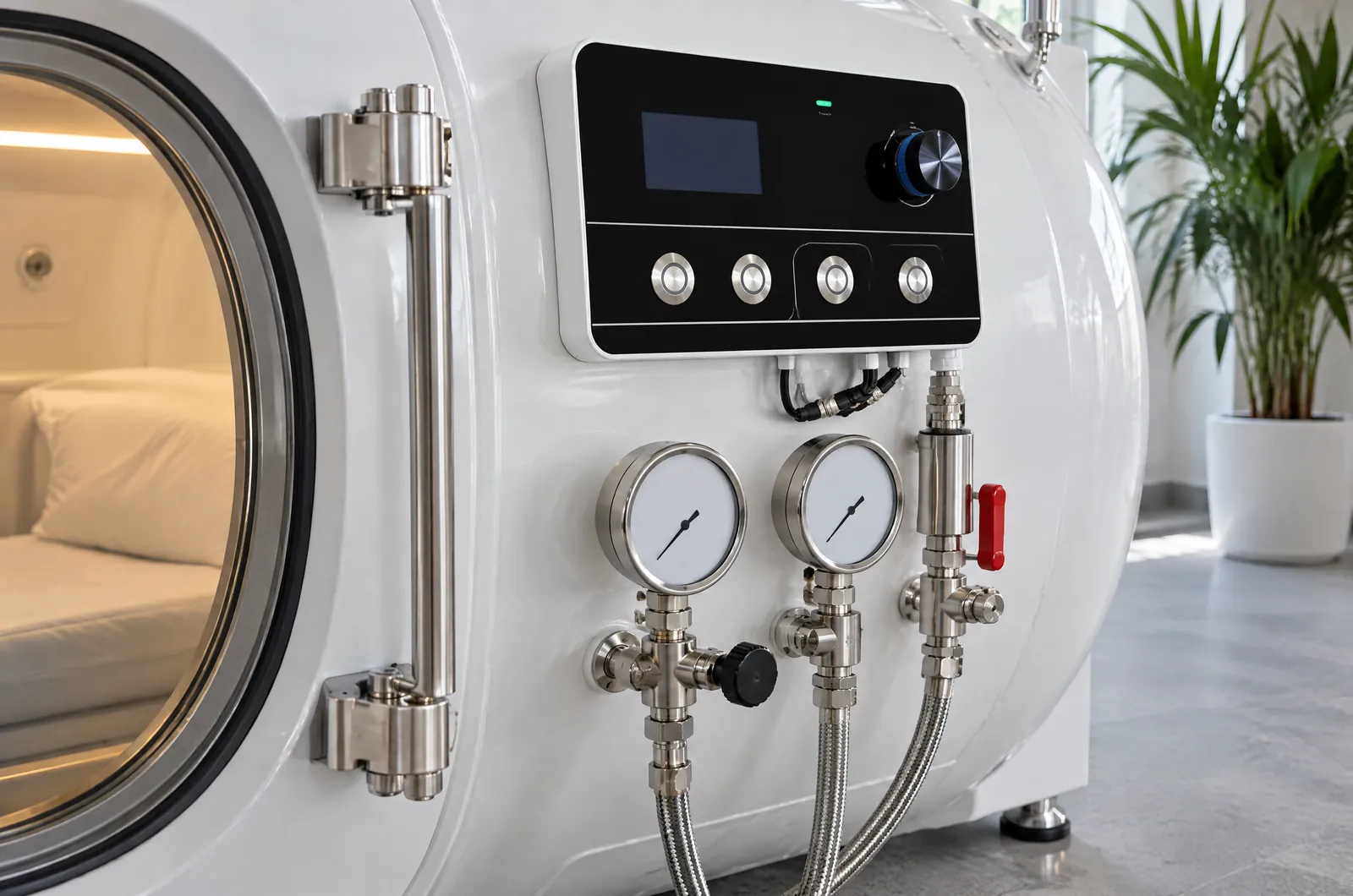
Each design moves the risk somewhere. An oxygen-filled chamber puts the whole atmosphere at a high oxygen concentration, which is why monoplace programmes enforce strict rules on clothing and objects. An air-filled chamber with BIBS keeps the cabin near normal oxygen levels but depends on the mask seal and on the patient keeping it on. Ask which one you are buying and what the manufacturer’s instructions require of your staff.
Then ask where the oxygen comes from. Some newer chambers use an onboard concentrator instead of cylinders or a piped supply. That is convenient. But the UHMS definition calls for oxygen above 99.0% purity, so a clinic planning to deliver the therapy as UHMS defines it should get the delivered purity at the mask in writing.
The support units behind a hard-shell chamber: air compressor, oxygen concentrator and chiller, compared with tank supply. (5 min)
Fire safety is not a formality
In August 2025 the FDA sent a letter to health care providers after reports of chamber fires that caused serious injuries and deaths. It cited the heightened fire risk of high oxygen concentrations and said root causes had not been determined. Its requests were basic: follow the manufacturer’s instructions for use, keep staff trained, monitor patients, maintain the equipment, keep prohibited electrical and static-generating items out, and use hyperbaric-compatible clothing such as cotton. A vendor whose instructions for use you have not seen has not answered item 5.
Patient-side rules cost staff time too. Mayo Clinic tells patients that lighters and battery-powered devices that generate heat are not allowed in the chamber, and that hair and skin products such as lip balm, lotion, makeup and hair spray should not be worn. Someone has to check for all of that before every session.
Staffing and certification
The chamber does not run itself, whatever the touchscreen suggests. Hospital programmes typically staff with a supervising physician and technicians who hold the Certified Hyperbaric Technologist (CHT) credential from the National Board of Diving and Hyperbaric Medical Technology. The board approves the training courses, and graduates become eligible for the CHT exam only after a defined preceptorship period; nurses have a parallel credential, the CHRN. A clinic buying its first chamber should budget for that course, the preceptorship time and the exam, separately from whatever on-site handover the vendor includes. Vendor training teaches you the machine. Independent certification is what a surveyor, an insurer or a lawyer will ask about.
The room is part of the purchase
Read the installation drawings before the quote is signed. Perry Baromedical’s published site requirements for its Sigma 34 monoplace are a useful benchmark: a medical gas supply at 50 to 90 psi delivering 30 standard cubic feet per minute, a copper exhaust line of at least 1.5 inches run to the outside of the building at least eight feet above chamber level, away from any ignition source, and flooring that does not build static charge, with carpet not recommended. The chamber alone weighs 2,200 lb. Its larger Sigma 40 weighs 2,850 lb and needs 40 cubic feet per minute. All of it lands on the building budget, not the equipment line.
Air-filled seated chambers shift the burden rather than remove it. They need floor space, ceiling height, a compressor and an oxygen source, but not an oxygen-rich exhaust line. Ask for the drawings either way, and walk the delivery route: doorways, corridor turns, lifts and floor loading are where installations stall.
Doorway widths, room size and power for a chamber install, and why some systems ship as modular sections. (4 min)
Capacity math
Mayo Clinic puts most sessions at 1.5 to 2 hours and notes that non-healing wounds may need 40 sessions or more. That makes chamber-hours the real constraint. A rough illustration: if one seat runs four sessions in a working day, five days a week, it delivers 20 sessions a week. A wound patient attending daily uses five of them, so one monoplace chamber supports about four patients in an active course at a time, and each course runs eight weeks or longer. A four-seat chamber running the same schedule supports roughly four times that, with one operator. Turnover, cancellations and staffing will cut into those numbers, but they explain why multi-occupant designs appeal to clinics that want volume.
Four categories, scored
The table below scores the four chamber categories a clinic is likely to be quoted, on a 1 to 5 scale. These are editorial judgements against the documents above, not test results, and individual models vary inside each category.
| Criterion | Soft-shell (mild) | Hard-shell monoplace | Seated multi-occupant hard-shell | Hospital multiplace |
|---|---|---|---|---|
| Meets UHMS pressure floor (2.0 ATA) | 1 | 5 | 4 | 5 |
| Regulatory paper trail | 2 | 5 | 3 | 5 |
| Oxygen-delivery flexibility | 2 | 3 | 4 | 5 |
| Fire-risk profile | 3 | 3 | 4 | 4 |
| Patient throughput per operator | 1 | 2 | 4 | 5 |
| Room and installation burden | 5 | 3 | 3 | 1 |
| Capital cost (5 = lowest) | 5 | 3 | 3 | 1 |
| Staffing burden (5 = lightest) | 4 | 3 | 3 | 1 |
| Total (out of 40) | 23 | 27 | 28 | 27 |
The totals are close on purpose. They say less than the rows. A wound-care service treating diabetic foot ulcers under UHMS indications should read only the first two rows and ignore the totals.
For quick reference, the typical numbers behind those scores:
| Category | Typical working pressure | What fills the chamber | Patients per session | Billable under NCD 20.29? |
|---|---|---|---|---|
| Soft-shell (mild) | 1.3 to 1.5 ATA | Air, with oxygen by mask on some models | 1 | No: below the UHMS 2.0 ATA bar |
| Hard-shell monoplace | Up to 3 ATA | Usually 100% oxygen; some offer air | 1 | Yes, for listed conditions, if cleared and supervised |
| Seated multi-occupant | Up to 2.0 ATA | Air, with oxygen by mask or BIBS | 2 to 4 | Depends on clearance and oxygen purity; ask |
| Hospital multiplace | Usually 2 to 3 ATA | Air, with oxygen by hood or BIBS | Many, plus an attendant | Yes, for listed conditions |
Soft-shell (mild) chambers
Portable fabric chambers inflated by a compressor, typically at 1.3 to 1.5 ATA. OxyHealth’s Vitaeris 320 is the best-known example: 1.3 ATA (4 psi), 510(k)-cleared as a Class II device, sold with a five-year warranty. Superhuman’s S1 sits in the same category at a selectable 1.3, 1.4 or 1.5 ATA, filled with air with oxygen delivered by mask. Everything in this class falls below the UHMS 2.0 ATA definition and inside the range it calls mild. Fine for some wellness settings. Not a wound-care purchase.
Hard-shell monoplace
The hospital workhorse: an acrylic tube for one patient lying flat. Sechrist’s 3300H/3600H and Perry Baromedical’s Sigma line (the Sigma 34 is rated to 3 ATA, 30 psi, with a 33.5-inch internal diameter and an air/oxygen select option) are the names most wound-care centres will recognise. Size is the comfort variable: the Sigma 40 widens the tube to 40.5 inches, and Perry rates it for patients up to 700 lb and describes the extra space as a way to reduce claustrophobia-related non-compliance and treat bariatric patients, a point a metabolic surgery practice will notice. Perry lists emergency decompression from 3 ATA to 1 ATA at about 100 seconds for the Sigma 34 and 120 seconds for the Sigma 40. The paper trail is the strongest in the market, and so are the facility demands: oxygen supply, venting, and one operator per chamber in most setups.
Seated multi-occupant hard-shell
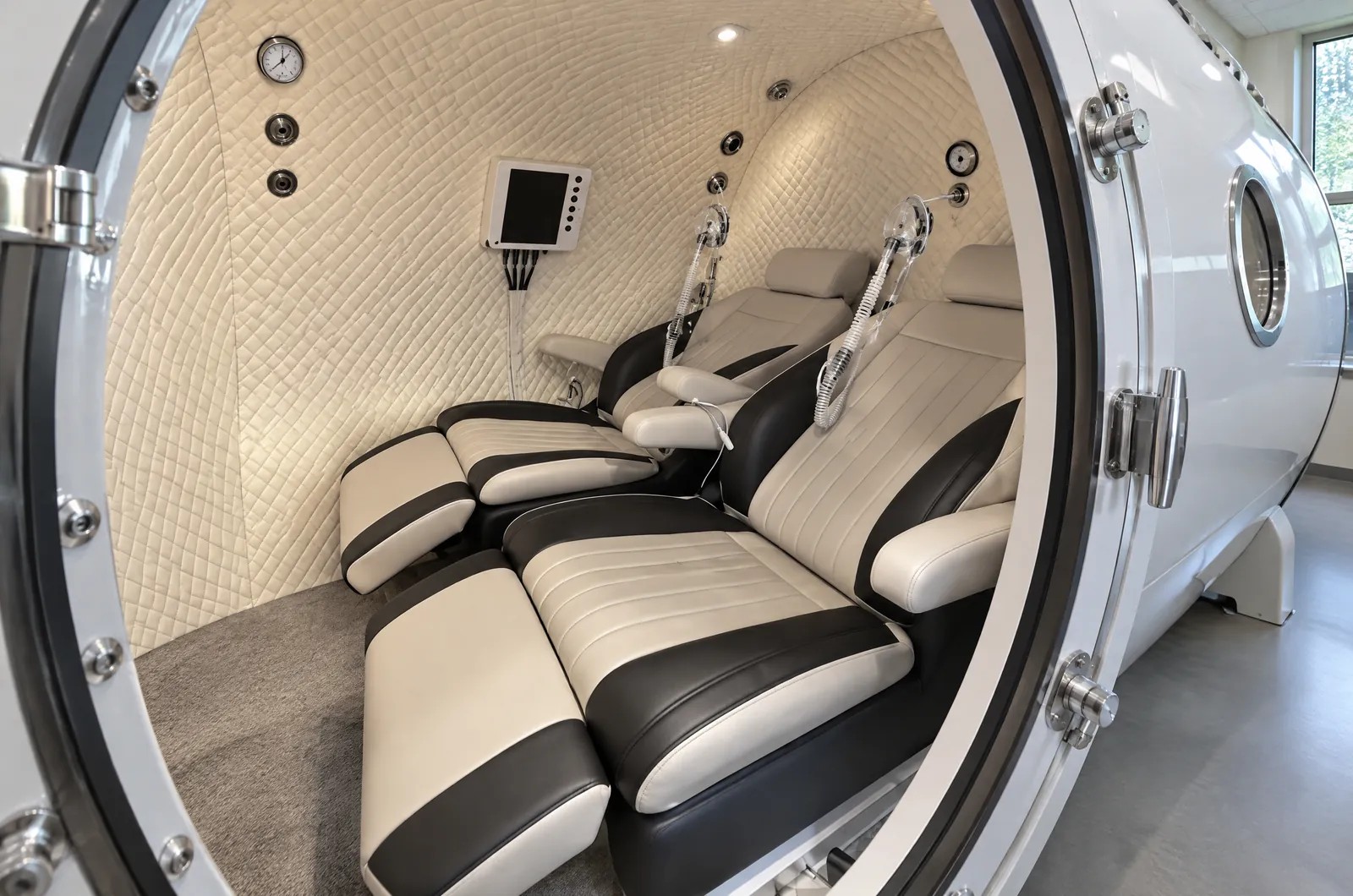
A newer category aimed at clinics that want more than one patient per session without building a hospital room. These are air-pressurised steel chambers with seats, with oxygen by mask or BIBS. Superhuman’s T2 seats two at 2.0 ATA (1.5 selectable), in a footprint of about 6 ft 10 in by 5 ft 5 in with a roughly 6 ft ceiling, and uses an onboard concentrator so there are no tanks to refill. Its T4 seats four with BIBS. The company says both are built in an ASME-certified factory with vessel designs tested to PVHO-1, and that it trains a clinic’s operator on site during installation. Prices start at $99,900 for the T2 and $169,000 for the T4. On the product pages we read we did not find a 510(k) number, so item 1 on the checklist is a direct question to ask. For a PT or metabolic clinic running supervised sessions for several clients at once, this category scores best on throughput per operator and fire-risk profile. Buyers wanting the vendor’s full argument can read a manufacturer’s own explainer on medical-grade criteria, and should then check it against the five documents above, as they would any vendor’s.
Hospital multiplace
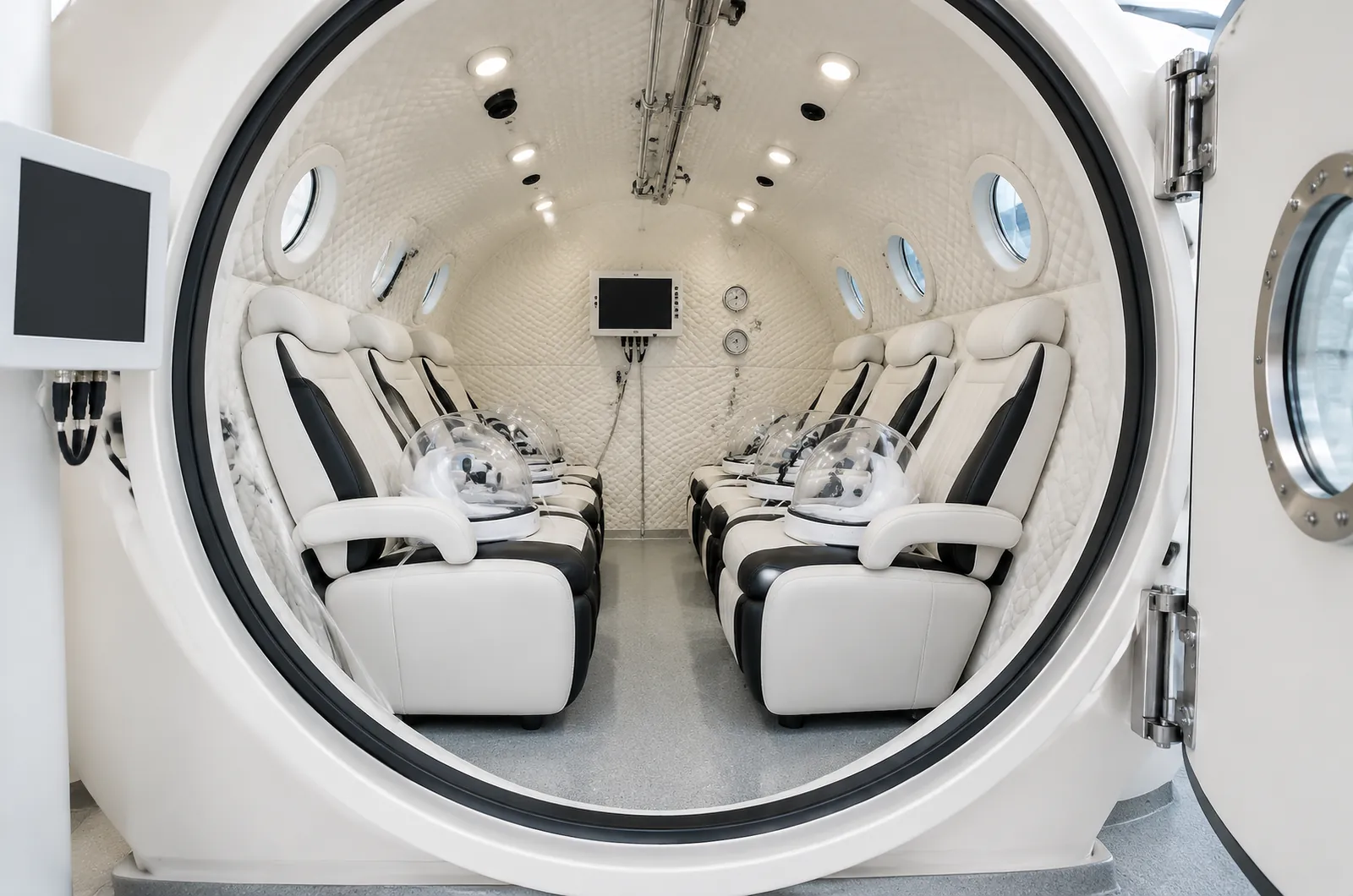
Rooms, not appliances: rectangular or cylindrical steel chambers that hold a group of patients and an inside attendant, with oxygen delivered by hood or BIBS. Fink Engineering, whose single-, double- and triple-lock chambers received 510(k) clearance in November 2024, HAUX-Life-Support and OxyHeal are among the established builders. They lead on every clinical criterion and trail on everything a stand-alone clinic cares about: floor space, structural work, cost and staffing.
Reading the scorecard honestly
Three points hold regardless of which category wins your shortlist.
First, buy against the indication you plan to treat. If it is on the UHMS list and you intend to bill for it, the bar is a cleared, hard-sided chamber at 2.0 ATA or more with medical oxygen, in a facility that can pass a UHMS or equivalent survey. If it is a wellness service, say so in your own materials and buy accordingly.
Second, ask for documents rather than adjectives. A K-number, a PVHO-1 test record, an NFPA 99 compliance statement, an instructions-for-use manual and a written service-level agreement will tell you more in an hour than any brochure.
Third, price the people. Over a chamber’s life, staffing, training, servicing and oxygen will likely add up to more than the purchase price. A vendor quote that leaves these out is not a full quote.
Questions buyers ask
Is “FDA-registered” the same as FDA-cleared? No. Registration lists a manufacturing establishment with the agency. Clearance is a 510(k) decision on a specific device under product code CBF, with a K-number and cleared indications you can look up in the FDA database.
Does a soft-shell chamber count as medical-grade? Not by the UHMS definition, which requires a hard-sided chamber at 2.0 ATA or more with oxygen above 99% purity. Some soft chambers hold their own 510(k) clearance for narrow indications, so read what the clearance actually covers.
Will Medicare pay for sessions in the chamber we buy? Only for the 15 conditions in NCD 20.29, delivered as whole-body treatment under the rule’s conditions. Diabetic foot wounds qualify only at Wagner grade III or worse after 30 days of failed standard care. Pressure ulcers and venous stasis ulcers are on the non-covered list.
Mask, hood or a chamber full of oxygen: which is better? Mayo Clinic says the treatment effect is the same in monoplace and multiplace chambers. The difference is in fire risk, patient comfort and staffing. Choose the design whose instructions for use your team can follow every day.
Do we need certified staff? The FDA asks facilities to keep staff trained on each device, and accreditors look for documented competency. Hospital programmes use CHT-certified technologists under a supervising physician.
This archive is independent of NIH, NIDDK, the FDA, the UHMS and every manufacturer mentioned. Specifications quoted come from manufacturer or FDA pages read in October 2026 and can change. Confirm them with the vendor before signing.
Sources
- U.S. Food and Drug Administration — Product Classification: chamber, hyperbaric (product code CBF, 21 CFR 868.5470, Class II, 510(k))
- U.S. Food and Drug Administration — Follow Instructions for Safe Use of Hyperbaric Oxygen Therapy Devices: Letter to Health Care Providers (25 August 2025)
- ASME PVHO-1 — Safety Standard for Pressure Vessels for Human Occupancy
- NFPA 99 — Health Care Facilities Code
- Undersea and Hyperbaric Medical Society — HBO Indications
- Centers for Medicare & Medicaid Services — National Coverage Determination 20.29: Hyperbaric Oxygen Therapy
- Mayo Clinic — Hyperbaric oxygen therapy (tests and procedures overview)
- Sechrist Industries — 510(k) summary K140559, Models 3300H/HR and 3600H/HR Monoplace Hyperbaric Oxygen Chambers (2014)